7 Years In - the 7 Stages of CrossFit

I walked into CrossFit Tysons Corner seven years ago at the end of September right after moving to the DC area, signing up for a monthly membership on October 1. Coach Matt told me, "We don't  have our regular workout today, but you're welcome to stay for Hoover Ball." Two  things about that: 1 - I had never been assigned a workout walking into a gym, and 2 - what the hell is Hoover Ball? I played the game - basically a version of Volleyball, where a medicine ball is tossed over a net and if it touches the ground, your whole team gets a penalty. After the workout, I thought to myself, "what a strange group of people."

Seven years later, I'm at the same gym as a trainer, and to say I've never looked back would be a lie. I would say a more accurate description is that I haven't found anything that can fill the efficiency in terms of time to results, camaraderie, or challenge that CrossFit brings. Those seven years include 4 half marathons, a Tough Mudder, the Civilian Military Combine, Parkour classes, (not enough) yoga classes, gymnastics classes, flag football, intramural soccer, countless 5 and 10Ks, hotel workouts, Planet Fitness doldrums, and skulling classes on the Potomac. All of those were fun, but not something that could hold my interest for a long time. Plus, I've made some really close friends through the gym (I still can't call it a box) that have become close to family. Blah blah blah, you've heard it before, I know. But I think anyone's relationship with CrossFit boils down to 7 stages. The stage you land on is up to you -- others more motivated, younger or with a better athletic background than me will blast through these stages in weeks or months, not necessarily years.

Stages 1 - 3: The beginning loop

1: Intro

For some reason, you find yourself in an empty warehouse space staring at a row of pull-up bars and squat racks. Blame it on your friend, significant other, magazine article, or the impending expiration of a Groupon, but you make it to your first class. The experience can vary - either you leave pumped and invigorated by the simple moves that leave you gasping for breath, or your head is swimming from the coach that validated his existence by every gymism or made-up CrossFit lingo that he can manage. Whatever, the first day is over.


2: Show Up

That first class at least caught your interest, and you come back. Or perhaps you signed up for a multi-week fundamentals course. Or perhaps you saw a cute guy/girl on your first day. And you come back again. And again. Nothing really sinks in, but you average 2 or 3 days a week, experiencing the high of finding a workout where you hold your own, and the low of watching someone with ___ body type do infinitely more weight than you in infinitely less time. For me, this period lasted longer than I care to admit. Probably a year or two, maybe three. I didn't make many friends in the gym (mostly because I didn't want to and was very quiet), and having just come from grad school, I didn't care to base my schedule around what seemed like a random workout. Depending on the gym though, this Show Up phase could incorporate a bunch of other phases. Maybe you stumbled onto a gym run by an inspired regional athlete, and you progress very quickly. Or on the flip side, maybe you've found a xfit spin-off, that uses konstantly varyed funxional movements at higher intensities. It's crossfit, not CrossFit and something has been lost in translation. If this is the case, you can unintentionally stay in Show Up phase for a long, long time.

3: YouTube Infatuation

YouTube, ESPN, Instagram, whatever platform. One day you type in the name of a workout or athlete you've heard of, and... House of Cards style, you forget when the last time you ate was because you're in click heaven. For some, this is their intro into CrossFit, skipping past the need for a friend to introduce them, and instead getting mesmerized by abs on dudes, or abs on girls, or maybe even videos that just mock CrossFit. Whatever the case, you realize that there is passion and results in the area of CrossFit, for or against the workout style. Here, you may gain a little knowledge, but more importantly, you realize that just showing up on a random schedule won't get you to YouTube fame very quickly.


4: Competition

At some point, whether it is the CrossFit Open, an internal gym competition, or signing up for an obstacle race or other "functional fitness" competition, you will compete in CrossFit. This is when you realize - "Damn, what have I been doing?" You see women flying through muscle-ups and old men lifting more than the best high school version of yourself. Or in my case, you ask for people's goals and realize you've been selling yourself short for too long. Even if you have no desire to compete again, the "Show Up" phase is over. You start to appreciate the coach's cues, or realize that your coach doesn't know what they're doing. You watch instructional YouTube videos, instead of performance videos. Maybe you sign up for a CrossFit certificate course or begin filming your own performance so that you can fix faults and not just show off. Maybe you visit a different gym on a road trip and get your a** handed to you at your best workout. At this stage, the progress comes quickly - you've mentally committed, and likely this stage also brings along diet changes - paleo, Zone, Whole 30, gluten free, Renaissance, you'll try anything your man crush suggests. Life is good, and the next competition is going to be different.

5: Breakup

Then, tragedy strikes. Anyone who tells you they have loved every single part about CrossFit forever and always is lying. As the sport and fitness trend expands, so does the chance to run into someone who rubs you the wrong way. Do you love everyone at your job or in your extended family? Do you expect to love every CrossFitter? Probably not. So maybe it's a personal conflict that fuels the breakup with CF. Maybe your only interest was in dating a guy/girl in the gym, and for whatever reason, CF fizzles along with your love for him/her. Or, a likely scenario is that you run into an injury. CrossFit, if done correctly, does not mean you will eventually get injured. But what's more likely is that in your "Show Up" phase, you didn't take the fundamentals to heart. You could muscle through a handstand, do curls for cleans, or develop bad habits while squatting. It happens to everyone. The best gyms will help you avoid this phase. But sometimes, they can't save you from yourself. On top of CrossFit, you're going to night classes and sleeping 4-5 hours a night, training for a 10K, and doing adventure races. You've also cut out meat and count calories, because that is "healthy". You don't tell the coach because you want to prove you can improve on the previous competition. You ignore a twinge or tweek during a workout, and then... it's breakup consideration time as you lie on the physical therapy or massage table. From here, you either ease yourself back into CF land with a new perspective or you walk away from CF, realizing it's just not for you.

6: Education

The only way to really break out of the intro cycle through breakup, is to educate yourself. Even if it's admitting that there's one coach at your gym has never really helped you, that's education. Shifting your schedule to avoid that coach, or trying other gyms - that's still education. That doesn't mean he or she is a bad coach, more likely that they're a bad coach for how you learn. You don't have to go through pre-med curriculum to educate yourself, but you will need to be more proactive. Everyone responds differently and learns differently. For me, I realized that I react defensively to cues if I don't understand them. My only way to improve was to see my own errors, and then I am OK if a coach reminds me and helps me to correct them. It's made me sign up for the CF Level I cert (I had no intention of becoming a coach), because I felt I was missing the link between programming as a whole and an individual workout. The need for education made me sign up for the CF Level II cert because I realized I didn't have confidence in my coaching abilities.

7: The Decision

Once you admit to yourself that you don't know everything, the sky is the limit with CrossFit. Do you want to help others avoid your mistakes by becoming a coach? Have you continued to improve exponentially after going back to basics in your education phase and you know that you have the mindset for competition? Have you seen a gap in the products out there or gyms in your area that you can serve with a business idea? Or do you realize that CrossFit helps you in other aspects of your life and realize that CF workouts 3-4 times a week is just what you need to have a better lifestyle? After 7 years, I think the biggest mistake in CrossFit is that people try to skip from YouTube infatuation to Elite Competition without the in between steps. If you're 18, you can probably do this without too much pain. If you're 28, that window is incredibly small to get right. It requires the right combination of coach, gym environment, humility, and competitiveness that sometimes leaves people broken.

You can do the things that make you you without putting CrossFit front and center.

After 7 years, I'm still learning that there is nothing wrong with CrossFit as a lifestyle. It helps you play with your kids, you can run a 10K or mud run without too much additional effort. You can still go to yoga/swimming/knitting/book club without having to wake up at 5AM and prepare bottles and tupperware to get you through the week. You can do the things that make you you without putting CrossFit front and center. My elite competition window has closed, but that doesn't mean my education and coaching phase needs to end. An effective trainer teaches, sees, corrects, manages groups, has presence and attitude, and demonstrates movements perfectly. Its the last two areas of presence/attitude and demonstration that I'm pretty sure I can spend the next 7 years on, and that's fine with me. My path to better demonstration will involve yoga, olympic lifting, mobility (oh so much mobility) and gymnastics instruction. That's not a short road for someone who's 30, and that's OK. Eventually, I do want to take the CF Level III cert, so I can officially earn the title of Coach, even if I don't coach a day after I pass that milestone. I don't think CrossFit is going anywhere any time soon. Perhaps it's not for you, but if you've already given it a try, why not make sure you get to step 6 before hanging up those high socks?


A trek above the clouds: Choquequirao

After the jokes have been told, anecdotes have been recounted, and the short list of songs that you can sing from memory harmonized, that is when the true hike begins. It's at this point when the rhythm of the trek becomes consistent - heavy breathing accompanied by the comforting click and reverberation of my hollowed-out cornstalk walking stick and the staccato accents of zippers and bug spray squirts. These are the true soundtrack of a long hike. We had moved past sharing our personal details with the guide - cuantos hermanos? Uno. en que trabajas? Ingeniero. Como te gusta Peru? Er... me gusta pisco.

With my broken Spanish, it didn't take long to go through the pleasantries, but Sofia's knowledge and experiences living in Peru made the conversations during the hike to Choquequirao flow for the first 2 days before we got to where the real fun began.

Choquequirao is a lesser-known historical Inca site about 20 miles southeast of Machu Picchu as the condor flies. And if you're doing the extended trek from one to the other, I'm sure you will envy the scrawniest of condors, as the hike to Choque is daunting. To give an idea, the roughly 17 mile trek starts out modestly, climbing from 9000 ft in elevation to 9750 ft over the first 7 miles. Then the fun starts on the second day. 


The second day has you descend close to 5000 ft over 4.5 miles in a dizzying series of switchbacks. My only thought while completing this was "don't think about the way back up." Our guide, Alex, did a good job of distracting us, telling us jokes like - "a horse walks into a bar. The bartender asks, why the long face?" Jajajaja. Or this classic genie joke as told by Alex - "I have a wish to get with the most beautiful woman in the world, one man tells a genie. Instantly, the genie does his thing and Mother Theresa is by the man's side. No, no, no - you don't get it, continues the joke.  Beautiful! She beautiful like you said, the genie explains. No, let me try again - I want to have a... er... dick that touches the ground." Alex gives a wry smile. "And so genie responds by chopping off the man's shins." Jajajajaja. "It's good, right?" Alex pleads for some confirmation.

And so it was that this was our guide, who would lead us through the names of towns that sounded like tasty dishes to me - the descent from Capuliyoc through Chikiska and Cocamasana to Playa Rosalinda, close to the Rio Apumirac valley. What could go wrong?

We descended dutifully on the second day, getting to Chikiska around noon, watching all of the travelers collapse on a mosquito-filled bench in the middle of the camp, looking like the opposite of an REI ad. Shoes were untied, intentionally or not, water pooled wherever the bottles ended up after a last sip, eyes were glazed behind sunglasses neither functional or fashionable. It was the bench of exhaustion - or the bench of dread. "Really? We have to go back that way?" or "Really? The ruins were amazing, now we just want an elevator." Sofia and I thought we were tired, but in good spirits. Nothing an Inca Kola and a few mana sugary corn snacks couldn't take care of.

We camped (against the advice of reviews we had read) next to the mosquito-breeding river, putting up a not-so-eipc fight against the mosquitoes to battle another day. Questionably refreshed, and ready to see the ruins, it was the third day that tested us. We started out at the base of the river valley, hiked up 5000 ft of elevation in 5 miles to arrive at the beautiful, water-filled, orange-filled city of Marampata. Or perhaps it was a small collection of houses with a few snacks and drinks to sell. Never trust what you eat on a hike, because if you attempt to duplicate how delicious a meal of luke-warm spaghetti and hot sauce is in your daily life, you're sure to be disappointed. But Marampata was beautiful.

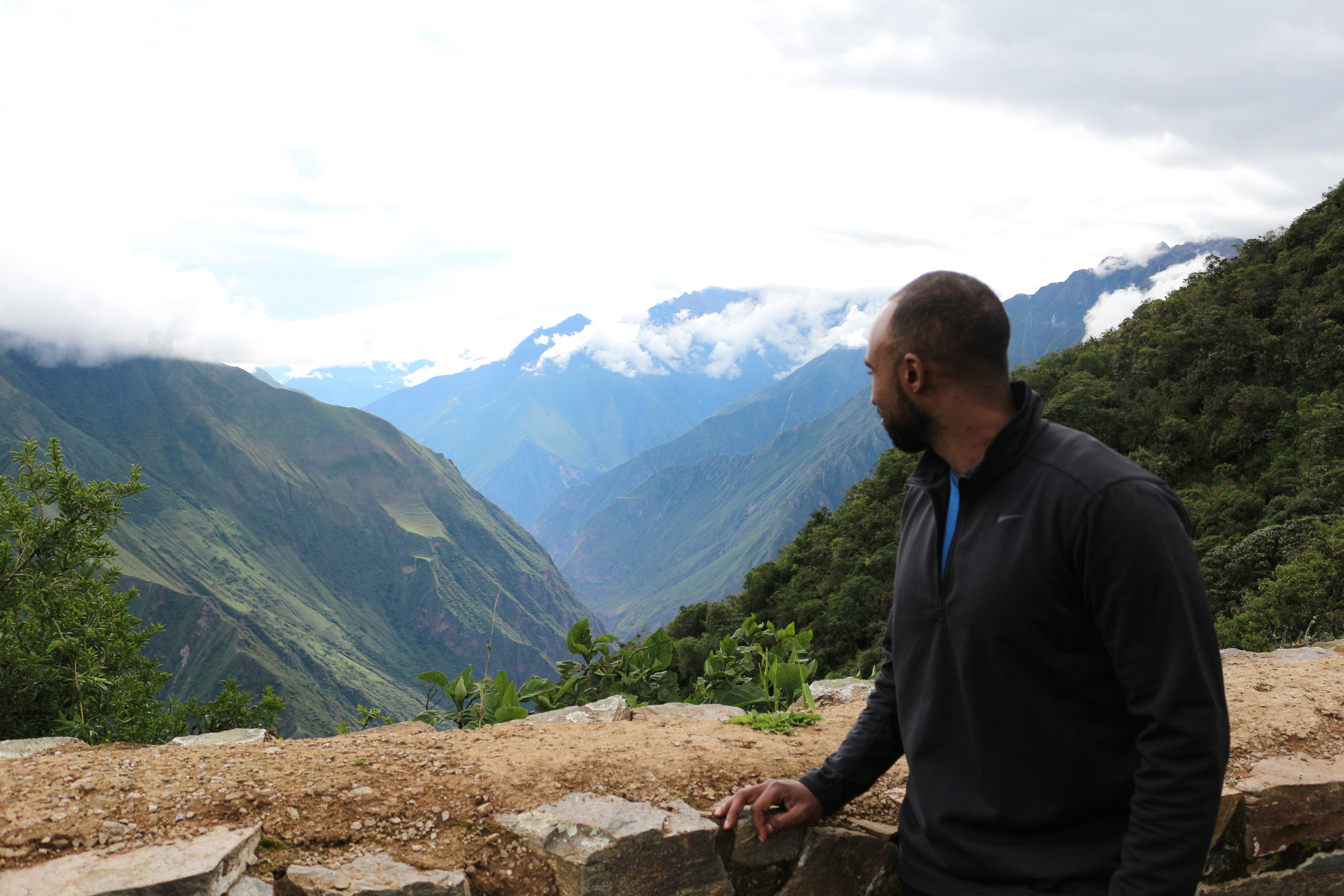
The whole hike was beautiful, to be honest. Our choice to go at the end of the rainy season was the perfect timing of the weather not being too cool and the scenery being Shire green. As Sofia exclaimed over and over, it reminded her of the hills of New Zealand - blue sky, impossibly verdant carpeted hillsides, and crayola-bright wildflowers everywhere you looked. To me, it was reminiscent of  a painting on all sides - anywhere you focused, it could be a still life snapshot. Do I want to paint birds and shadows, clouds and dancing sunbeams, flowers and running water? No canvas would be any less inspiring.

And that was before the city of Choquequirao itself. Better writers than I have described the architecture and significance of the ruins - these were the articles that led me to the trek in the first place. But you don't have to be a writer to appreciate what Alex told us of the meticulous stonework of the Incas - 8 degree incline or decline for all walls to better deal with earthquakes, stones that sit flush against one another for places of royalty. There were areas of religious importance - to worship the sun and moon by men and women respectively, and of strategic importance - terrace after terrace for battle training, and agriculture, as well as a viewpoint to observe and plan against threats from all sides. When we arrived at the site, unlike Macchu Pichu, on Easter Sunday, we were the only ones there. We could take our time to observe what the ruins had to offer without distraction or salesmen. While the hike and surrounding towns could use some improved infrastructure, I hope it it's a long time before the planned cable car from Santa Rosa to Marampata transforms Choque into another bucket list item visited by millions each year like Machu Picchu.

Choquequirao, like all important Incan cities, is laid out in alignment with the movements of the sun and the stars. One building on the central plaza has nooks in which the mummies of important citizens were placed, and it is onto these nooks that the first rays of dawn fall each day.

The city’s central temple is a small rectangle on the other side of the plaza with evenly spaced depressions for altars and stone hooks where the priests hung their raiment. The most striking feature about the temple is how tiny it is; like those at Machu Picchu, it could fit perhaps 20 worshipers and had very little of the architectural grandeur of a mosque, a church or a synagogue. But then, an attempt at human grandeur here, in the shadow of the jagged jungle peak Corihuayrachina and facing arid, domelike mountains so gargantuan they make clouds look small, would seem redundant at best.

Although Choquequirao is more spread out than Machu Picchu, and therefore less photogenic, the promontory on which it lies reaches its zenith with a ceremonial hill behind the plaza, a smaller version of the rugged mountain seen in every photograph of Machu Picchu. The hike up takes just a few minutes but affords a 360-degree view of the ruins and the surrounding landscape. The curious feature of the hill is that it was scalped, flattened and denuded of vegetation by the Incas so their priests could perform rituals there. (NYT 2007)

But unfortunately or trek did not end with teleporting from the ruins into a bar filled with Pisco drinks and Marinera dancing. We still had to return to our river valley campsite, 5000 ft down the mountain, and thanks to the careful planning of Alex, we would be completing this part of the hike in darkness. And it's here where the soundtrack of shuffling feet and hiking sticks received a welcomed addition. As we left the gates of Marampata, another guide joined us, Sombra, I named him after the spanish word for shadow, a black, collie-looking dog with white paws perfect for following in the waning sunlight led us down the mountain. As Alex said, you never question when you're given an animal to guide you. Long after our questionable jokes and more questionable Disney song lyrics had been shared, it was Sombra who proved to be the best guide - patient but watchful, silent but powerful, Sombra led us down the mountain, inspiring us to continue while providing the safety needed to be brave.

We had experienced Choque - a little bit spiritual, a little bit physical, a little bit ancestral, it's a place where what you interpret is above the clouds - nature or otherwise - can be met in solitude.

Why I will always be an average CrossFitter (and that's OK)

In 2011, I learned about the CrossFit Open after doing CrossFit in a very unfocused way for a few years. The first workout of double-unders and snatches at 75 lbs. I could have struggled through, but after that one, all of the weights listed seemed like a pipe dream. Loadings that are now commonplace, like overhead squats at 120 lbs. were not in my world of possibility back then.

Knowing you can't accomplish the minimum amount to enter a competition, let alone be competitive in it is a dose of reality we tend to avoid. I always think back to one of the first running races I signed up for, and one of my non-runner friends asked - "are you going to win?!" It seems like a reasonable question, I mean why enter something if you don't think you can win? I laughed at the idea of entering to win and moved on. Entering activities that you know you will win is like repeating the second grade over and over because you were good at it. Sure you will be the best, but that doesn't mean you're getting better.

Entering activities that you know you will win is like repeating the second grade over and over because you were good at it. Sure you will be the best, but that doesn't mean you're getting better.

Bet here we are, it's my fourth year of entering the CrossFit Open and each year it becomes more and more difficult to even win within my own gym (I did not), let alone the entire CrossFit community. This post is not about me giving up, or being realistic with my abilities. It's about priorities.

Every year in CrossFit, I learn a little bit more. I learn bad habits I've developed or additional exercises I should adopt. I learn what amount of volume my body can handle or when too many rest days become a pattern and not a decision. As a trainer, it's becoming even more apparent that the amount of time I have to devote to CrossFit could be used to help many get to a certain level of proficiency or I could use that amount of time to focus on myself being able to get a few more reps each year. 

am the 50th percentile... I can have confidence that my "average" score will be something to strive for in the eyes of new members, and a pacing benchmark for experienced members.

I've decided that my scores are a piece of data and nothing more. It's a good indication of my areas of weakness, and (sometimes) my areas of strength. The best thing the Open has done for me though is reinforce that I am the 50th percentile. In a school setting, that would mean I get a C. In grad school, that's failing out. But for me, in CrossFit it's a green light. Because what does the 50th percentile mean? It means as someone who helps to decide the workouts at our gym, when I complete a series of workouts, I can have confidence that my "average" score will be something to strive for in the eyes of new members, and a pacing benchmark for experienced members. It will give an idea if a workout is too long or too short, too heavy or too light. Eventually, with hard work, I've been able to complete those first workouts from Open 2011. And if I can do it, I know that some people will get those abilities faster, some slower. But everyone can get there, because if an average guy can get there, anyone can get there. To me, that is a beautiful thing.

Now does that mean I don't want to get better? Hell no. No one wants to end a workout on the floor in a puddle of sweat only to look and see that 60,000 people did better than them. But it means that as I improve every year, so does the rest of the growing CrossFit community. Staying in a consistent percentile each year is as much of a challenge as climbing a few spots. In 2013, I didn't get a muscle-up in the Open. In 2015, I got a muscle-up along with the 10,000 other people who had the same score as me in that workout of 2013. I improved, but so did many others, and that's OK. There are moves and techniques that I will work on in an effort to be a better trainer. If that makes me a better athlete (and it should), then that's a bonus. 


My priorities right now are being fit enough to not worry about day-to-day trials like sprinting up an escalator to catch a train, helping friends move and not being laid out the next day, or knowing that if I try a new sport like rock climbing or more competitive cycling, I do not have to start from scratch. Fit enough so that my only worry in preparing for a 3-day hike is how the altitude will affect me, not whether my legs will be sore. But mostly I want to be fit enough to make other people curious enough how they can begin their own health journey and maybe inspire them along the way.

Average? Why thank you.